Slow Cooker Vegetable Beef Soup Recipe
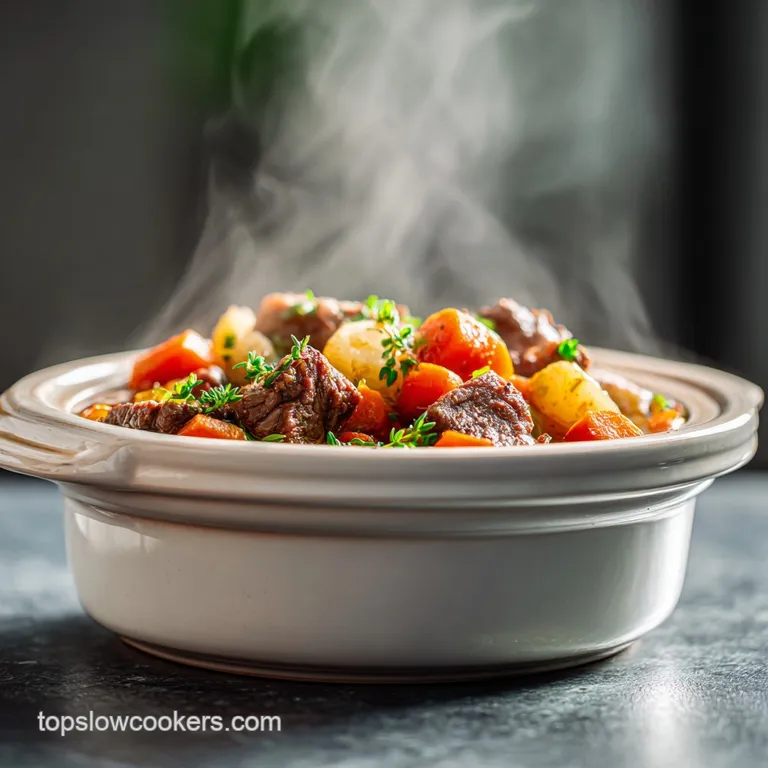
- Time: Active 20 minutes, Passive 8 hours, Total 8 hours 20 mins
- Flavor/Texture Hook: Savory broth with velvety potatoes and tender beef
- Perfect for: Traditional Sunday family dinners and stress free meal prep
- Making the Best Slow Cooker Vegetable Beef Soup
- Mastering the Beef Searing Process
- Essential Recipe Time and Yields
- Selecting the Best Soup Ingredients
- Recommended Kitchen Tools and Gear
- Simple Cooking Steps for Success
- Fixing Common Beef Soup Issues
- Smart Flavor and Meat Swaps
- Storing and Reheating Your Leftovers
- Serving Suggestions for Hearty Meals
- Very High in Sodium
- Recipe FAQs
- 📝 Recipe Card
Making the Best Slow Cooker Vegetable Beef Soup
There is a specific sound the heavy thud of a 2 lbs (900g) beef chuck roast hitting the wooden cutting board that always signals the start of a productive Sunday.
I remember the first time I made this; the kitchen filled with the scent of searing fat and earthy thyme, and I knew right then it was going to be a permanent favorite. It is the kind of savory aroma that wraps around you like a heavy wool blanket when you walk through the door after a long day in the cold.
We have all had those watery, gray soups from a can, but this version is entirely different. It is thick, substantial, and honestly, the best way to use up those extra potatoes in the pantry.
By the time the eight hour timer dings, the beef has surrendered its toughness and the broth has taken on a deep mahogany hue that looks like it came from a high end bistro. You’ll want a thick slice of crusty bread nearby to catch every drop of that velvety liquid.
Mastering the Beef Searing Process
The Collagen Conversion: Low heat over 8 hours converts tough connective tissue into gelatin, providing a rich mouthfeel without adding heavy starches.
This process requires sustained temperatures between 70°C and 80°C to ensure the meat fibers separate easily.
- Maillard Reaction: Searing the beef cubes in a pan before adding them to the slow cooker creates complex flavor compounds that a simmering liquid simply cannot produce.
- Starch Gelatinization: The 1.5 lbs (680g) of Yukon Gold potatoes release just enough starch during the long cook to naturally thicken the broth without needing a flour roux.
- Acid Balance: Adding 1 tbsp of balsamic vinegar at the very end "wakes up" the heavy fats, cutting through the richness to highlight the individual vegetable flavors.
- Aromatic Infusion: The 2 bay leaves and 1 tsp of dried rosemary release fat soluble oils slowly, ensuring the herbs don't become bitter over the long cooking cycle.
| Beef Thickness | Internal Temperature | Rest Time | Visual Cue |
|---|---|---|---|
| 1 inch cubes (2.5 cm) | 90°C+ (after slow cooking) | 5 minutes | Meat shreds with a fork |
| 1.5 inch cubes (3.8 cm) | 90°C+ (after slow cooking) | 10 minutes | Dark brown exterior, tender core |
| Whole Roast | 90°C+ (after slow cooking) | 15 minutes | Pulls apart in large chunks |
Deciding how to cut your meat changes the final texture significantly. If you prefer distinct, bite sized pieces that hold their shape, stick to the 1 inch cubes. For those who love a "shredded" feel similar to the technique used in our Slow Cooker Thick recipe, go for larger chunks that you can break apart right before serving.
Essential Recipe Time and Yields
| Component | Component Detail | Pro Secret |
|---|---|---|
| Beef Chuck Roast | High connective tissue | Always sear first to lock in the savory depth. |
| Yukon Gold Potatoes | Medium starch content | They hold their shape better than Russets in long cooks. |
| Fire Roasted Tomatoes | Charred acidity | The smokiness adds a layer of "cooked all-day" flavor. |
| Beef Bone Broth | High protein/collagen | Provides a more velvety texture than standard store broth. |
Using high-quality bone broth is a trick I learned after years of making thin, disappointing soups. It adds a natural body to the liquid that makes the whole dish feel much more expensive than it actually is. It creates a base that is remarkably savory and coats the back of a spoon perfectly.
Selecting the Best Soup Ingredients
- 2 lbs (900g) Beef chuck roast: Cut into 1 inch cubes. Why this? It has the perfect fat to meat ratio for slow simmering.
- Substitute: Beef stew meat (it's often pre cut chuck or round).
- 1 large Yellow onion: Diced. Why this? Provides the foundational sweetness for the broth base.
- Substitute: White onion or two large shallots.
- 3 large Carrots: Peeled and sliced into 1/2 inch rounds. Why this? Adds natural sugar and bright color.
- Substitute: Parsnips for a more peppery, earthy vibe.
- 3 stalks Celery: Sliced. Why this? Part of the essential mirepoix for classic savory flavor.
- Substitute: 1/2 tsp celery seed if you're in a pinch.
- 1.5 lbs (680g) Yukon Gold potatoes: Cut into 1 inch chunks. Why this? They stay buttery and firm during long cook times.
- Substitute: Red potatoes (keep the skin on for texture).
- 4 cups Beef bone broth: Why this? Adds richness and essential minerals to the base.
- Substitute: Beef stock with 1 tsp of unflavored gelatin mixed in.
- 14.5 oz Fire roasted diced tomatoes: With juices. Why this? Fire roasting adds a subtle smoky note.
- Substitute: Standard diced tomatoes with a pinch of smoked paprika.
- 2 tbsp Tomato paste: Why this? Thickens the broth and deepens the red color.
- Substitute: 1/4 cup tomato sauce (reduce broth by 2 tbsp).
- 2 tbsp Worcestershire sauce: Why this? The ultimate umami booster for beef dishes.
- Substitute: Soy sauce or tamari for a similar salt profile.
- 3 cloves Garlic: Minced. Why this? Essential for a pungent, aromatic finish.
- Substitute: 1 tsp garlic powder added to the broth.
- Dried Herbs: 1 tsp Thyme and 1 tsp Rosemary. Why this? Dried herbs stand up better to 8 hour heat.
- Substitute: 1 tbsp fresh herbs added in the last 30 minutes.
- 2 Bay leaves: Why this? Provides a subtle herbal background note.
- Substitute: Omit if unavailable, but the flavor will be less "round."
- 1 cup Frozen corn and 1 cup Frozen peas: Why this? Adds sweetness and pop at the very end.
- Substitute: Frozen green beans or lima beans.
- 1 tbsp Balsamic vinegar: Why this? Brightens the heavy flavors and tenderizes the beef further.
- Substitute: Red wine vinegar or a splash of dry red wine.
- 2 tbsp Fresh parsley: Chopped. Why this? A clean, fresh finish to cut the richness.
- Substitute: Fresh chives or scallions.
Recommended Kitchen Tools and Gear
- 6 Quart Slow Cooker: Such as a Crock Pot or Hamilton Beach model. This size allows enough headspace for the liquid to bubble without overflowing.
- Large Cast Iron Skillet: For the initial sear. I prefer a Lodge skillet because it holds heat remarkably well, ensuring the beef doesn't just steam in its own juices.
- Sharp Chef's Knife: Essential for cubing the 2 lbs (900g) of beef and slicing those hearty carrots.
Simple Cooking Steps for Success
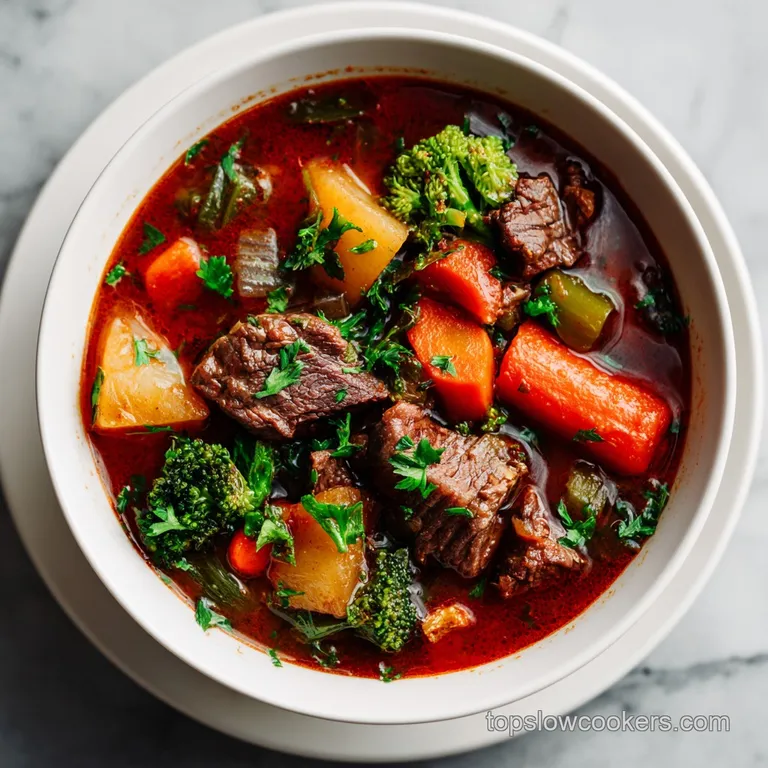
- Sear the beef. Heat a skillet over medium high and brown the beef cubes in batches until a dark crust forms. Note: Don't crowd the pan or the meat will steam instead of sear.
- Sauté the aromatics. Toss the diced onion and garlic into the pan for 2 minutes until fragrant and translucent.
- Deglaze the pan. Add a splash of the broth to the skillet, scraping up the brown bits (fond) with a wooden spoon.
- Layer the base. Place the potatoes, carrots, and celery into the slow cooker insert.
- Add the proteins. Transfer the seared beef and onion mixture on top of the vegetables.
- Pour the infusion. Stir together the bone broth, tomatoes, tomato paste, Worcestershire, thyme, and rosemary, then pour over the beef.
- Submerge the herbs. Tuck the 2 bay leaves into the liquid.
- The long simmer. Cover and cook on Low for 8 hours until the beef is fork tender.
- The final additions. Stir in the frozen corn, frozen peas, and balsamic vinegar 30 minutes before serving until heated through.
- Garnish and serve. Remove the bay leaves and sprinkle with fresh parsley before ladling into deep bowls.
Chef's Tip: Freeze your tomato paste in 1 tablespoon dollops on parchment paper. Once frozen, toss them in a bag. You’ll always have the perfect amount for this recipe without wasting the rest of the can.
Fixing Common Beef Soup Issues
Solving the Tough Beef Problem
If your beef is still chewy after the allotted time, it simply hasn't reached the temperature where collagen breaks down. This often happens if the slow cooker was opened too many times, letting the heat escape. Give it another 45 minutes on the High setting to push it over the finish line.
Solving the Watery Broth Problem
Sometimes vegetables release more water than expected. If the soup looks thin, take a ladle of the potatoes out, mash them in a small bowl, and stir them back into the pot. This creates an instant thickener that doesn't cloud the flavor.
| Problem | Root Cause | Solution |
|---|---|---|
| Dull flavor | Lacking acidity/salt | Add a pinch of salt or an extra teaspoon of balsamic vinegar. |
| Mushy potatoes | Wrong potato variety | Use Yukon Gold or Red potatoes next time; avoid Russets. |
| Greasy surface | High fat content in chuck | Skim the top with a wide spoon or use a fat separator. |
Common Mistakes Checklist
- ✓ Never skip the searing step; it is the difference between a "flat" soup and a savory one.
- ✓ Avoid the "High" setting for the full duration; the meat will often tighten up and become stringy.
- ✓ Don't add the frozen peas too early or they will turn a dull, unappealing gray.
- ✓ Ensure you use fire roasted tomatoes specifically for that hint of char.
- ✓ Let the soup sit for 10 minutes after turning off the heat to let the flavors settle.
Smart Flavor and Meat Swaps
Scaling Down (4 Servings): Use a 3 quart slow cooker. Reduce the beef to 1 lb (450g) and the broth to 2 cups. You can use a whole egg’s worth of liquid if you were baking, but here, just halve all measurements. Cook time remains roughly the same, perhaps reducing by 1 hour.
Scaling Up (16 Servings): Use two slow cookers. Do not just double the salt and spices start with 1.5x and taste at the end. Liquid can be reduced by about 10% as it doesn't evaporate as much in a larger mass.
The Potato Myth: Many believe that any potato works in a slow cooker. This is false. Russet potatoes are high starch and will disintegrate into a grainy mess over 8 hours. Always opt for waxy varieties like Yukon Gold to maintain that beautiful, velvety bite.
The Searing Myth: You might hear that searing "seals in the juices." Science shows this isn't true moisture still escapes. However, searing is mandatory for the Maillard reaction, which creates the deep, savory flavors that define a "best" soup.
| Component | Fresh Option | Shortcut | Flavor Impact |
|---|---|---|---|
| Garlic | Freshly minced cloves | Jarred minced garlic | Slightly more mellow, less sharp |
| Carrots | Whole peeled and sliced | Bagged "baby" carrots | Less sweet, slightly more fibrous |
| Broth | Homemade bone broth | store-bought stock + bouillon | Saltier, less body in the broth |
If you are looking for a slightly different flavor profile that still hits those comforting notes, you might enjoy the creamy finish of a Slow Cooker Beef recipe. It uses similar cuts of meat but leans into a tangier sauce.
Storing and Reheating Your Leftovers
Fridge Storage: This soup actually tastes better on day two! Store it in an airtight container for up to 4 days. The starch from the potatoes will continue to thicken the broth, so you might need a splash of water when reheating.
Freezer Instructions: This recipe freezes beautifully for up to 3 months. Leave about an inch of headspace in your freezer bags or containers, as the liquid will expand. To reheat, thaw overnight in the fridge and warm on the stove over low heat to prevent the potatoes from shattering.
Zero Waste Tip: Don't toss those celery leaves! Chop them up along with the parsley for the garnish. They have a concentrated celery flavor that is incredibly bright. Also, save your beef trimmings and vegetable peels in a bag in the freezer to make your own bone broth later.
Serving Suggestions for Hearty Meals
This slow cooker vegetable beef soup is a meal in itself, but it truly shines when paired with a side that can handle the heavy broth. A thick, toasted piece of sourdough or a crusty baguette is essential for "cleaning the bowl."
- If you want a crunch: Serve with a side of garlic rubbed crostini.
- If you want more greens: A simple arugula salad with a lemon vinaigrette cuts through the richness of the beef fat perfectly.
- If you want a classic pairing: Try it with a small dish of horseradish cream on the side for dipping the beef chunks.
For a restaurant quality presentation, serve the soup in wide, shallow bowls. Place a single sprig of fresh thyme on top and a crack of fresh black pepper. The contrast of the bright green peas and the deep red broth makes this look as good as it tastes. If you’re planning a bigger gathering and want more variety, consider serving this alongside a Slow Cooker Potato recipe to give your guests a choice between a clear broth and a creamy base.
Very High in Sodium
1140 mg mg of sodium per serving (50% % of daily value)
The American Heart Association recommends limiting sodium intake to no more than 2,300mg per day for most adults. Reducing sodium can significantly improve heart health.
Sodium Reduction Tips for Beef Stew
-
Low-Sodium Broth-30%
Swap the high-quality beef bone broth for a low-sodium or no-salt added beef broth. This simple switch can greatly reduce the sodium content without sacrificing flavor.
-
Fresh Tomatoes-20%
Replace the fire roasted diced tomatoes with fresh diced tomatoes. If using canned, opt for a no-salt added version and rinse before adding to remove excess sodium.
-
Limit Worcestershire-20%
Reduce the amount of Worcestershire sauce or use a low-sodium alternative. Even better, replace it with a blend of spices and a splash of balsamic vinegar for umami flavor.
-
Skip the Salt-15%
Omit adding any additional salt during cooking. Taste the stew after cooking and only add a pinch if absolutely necessary, as the broth and other ingredients already contain sodium.
-
Herb Power
Enhance the flavor with fresh herbs and spices! Experiment with different combinations of thyme, rosemary, pepper, and garlic powder to boost the taste without adding sodium.
Recipe FAQs
Can you cook meat and vegetables together in a slow cooker?
Yes, absolutely. The slow cooker excels at cooking protein and dense root vegetables concurrently, as the long, moist heat breaks down connective tissue while tenderizing the produce.
Can I put raw beef straight into a slow cooker?
No, you should sear the beef first. Searing develops the Maillard reaction, creating deep, complex savory flavors that boiling or simmering alone cannot achieve.
What seasonings do I use for vegetable beef soup?
Use dried thyme, rosemary, garlic, and bay leaves. Dried herbs withstand the long cooking time better than fresh ones, providing a steady aromatic base for the broth.
What are some common mistakes when making vegetable soup?
The biggest mistake is skipping the sear or opening the lid frequently. Searing builds flavor, and constantly opening the lid drops the internal temperature, preventing the tough collagen in the beef from breaking down properly.
Why are my potatoes turning to mush in the slow cooker?
You likely used high starch Russet potatoes. Opt for lower starch, waxy potatoes like Yukon Golds or Reds, as they hold their structure much better during the 8-hour cook time.
How do I ensure the broth is rich instead of thin and watery?
Use high-quality beef bone broth and sear the meat thoroughly. The gelatin released from the bones during the long simmer naturally thickens the liquid, providing a velvety mouthfeel, similar to the technique used in our Crock Pot BBQ recipe.
When should I add delicate vegetables like peas and corn?
Add frozen peas and corn only during the last 30 minutes of cooking. This allows them to heat through and retain their bright color and slight crunch without becoming overcooked and mushy.
Slow Cooker Vegetable Beef Soup
Ingredients:
Instructions:
Nutrition Facts:
| Calories | 444 kcal |
|---|---|
| Protein | 27.4 g |
| Fat | 21.2 g |
| Carbs | 21.8 g |
| Fiber | 3.9 g |
| Sugar | 5.8 g |
| Sodium | 1140 mg |
